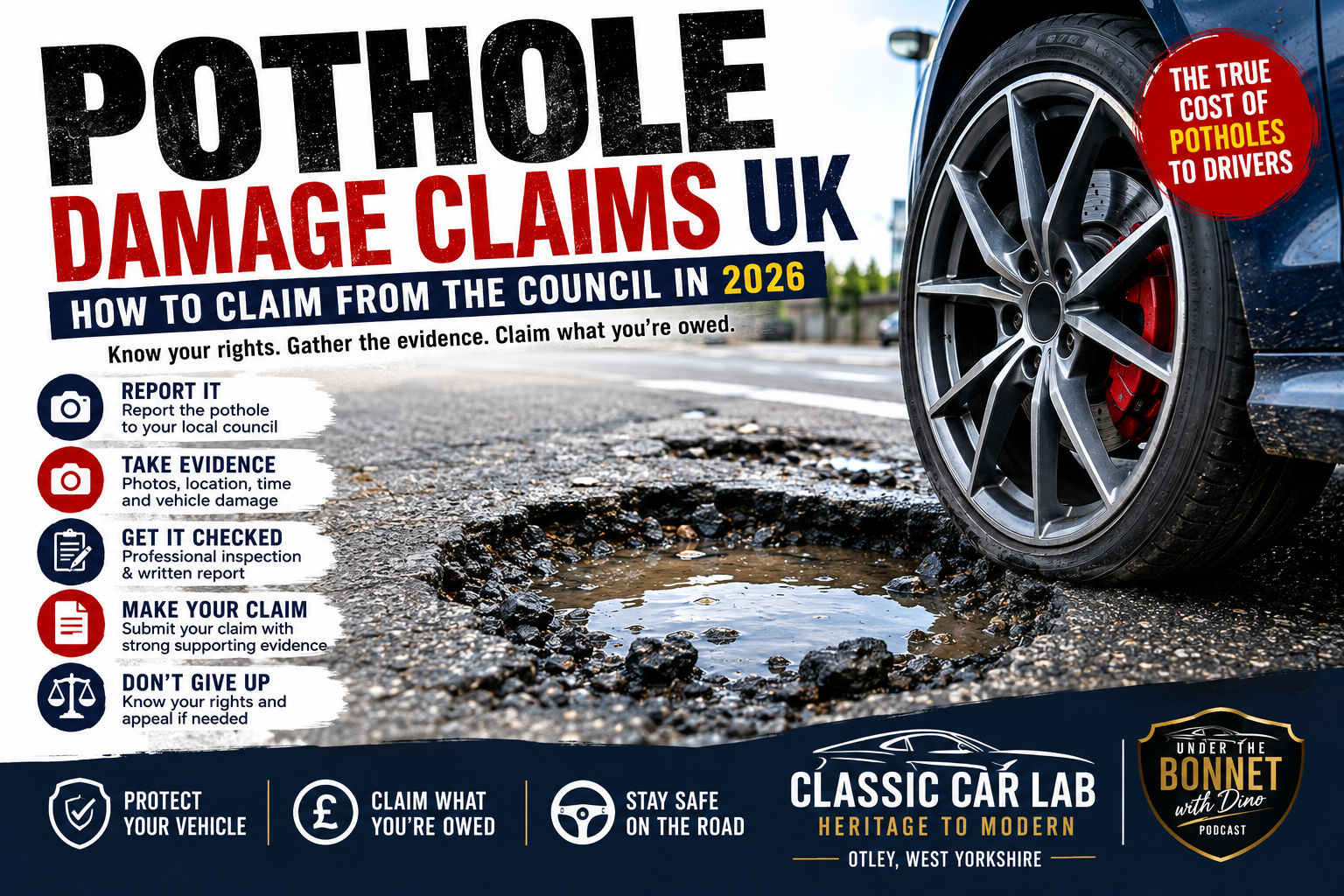
Pothole Damage Claims UK: How to Claim From the Council in 2026
Project Information
Project Description:
Pothole Damage Claims UK: How to Claim From the Council
Potholes are causing increasing frustration and expense for motorists across the UK.
At Classic Car Lab, we regularly see the consequences:
- damaged tyres
- bent or cracked alloy wheels
- steering misalignment
- broken suspension components
- damaged wheel bearings
- underbody impact damage
The damage is not always immediately visible. A vehicle may continue driving after the impact while a wheel, tyre, suspension joint or steering component has already been weakened.
This guide explains what to do after hitting a pothole, what evidence you may need and how to make a claim against the relevant highway authority.
Can you claim compensation for pothole damage?
You can submit a claim, but compensation is not automatic.
Highway authorities have a legal duty to maintain roads for which they are responsible. However, Section 58 of the Highways Act 1980 gives them a possible defence if they can demonstrate that they operated a reasonable inspection and maintenance system.
This means that the success of a claim may depend on questions such as:
- How long had the defect existed?
- Had it already been reported?
- When was that road last inspected?
- Was the defect recorded during an earlier inspection?
- Did the authority respond within its stated repair timescale?
- Was the pothole sufficiently serious to require intervention?
North Yorkshire Council explains that there is no automatic right to compensation and that a claim form does not itself count as reporting the road defect. The pothole should therefore be reported separately.
What to do immediately after hitting a pothole
First, move to a safe place before inspecting the vehicle or taking photographs.
Do not stand in a live carriageway or put yourself at risk to obtain evidence.
When it is safe, record as much information as possible.
Photograph the pothole
Take:
- a clear photograph of the defect
- a wider photograph showing the road and surroundings
- pictures from more than one angle
- an image that helps demonstrate its approximate size
- photographs showing nearby road signs, junctions or landmarks
Avoid placing an object inside the pothole if doing so would put you in danger.
Record the precise location
Write down:
- road name
- direction of travel
- nearest junction
- nearest building or landmark
- postcode, where known
- map location or phone pin
- date and approximate time
The more accurately the authority can identify the location, the easier it will be for the claim to be investigated.
Photograph the vehicle damage
Take clear images of:
- the affected tyre
- the wheel or alloy
- visible suspension damage
- damaged bodywork or undertrays
- dashboard warning lights
- any fluid leaks
Keep the original photographs rather than relying only on compressed copies sent through messaging apps.
Report the pothole separately
Reporting the defect and submitting a compensation claim are usually two separate actions.
The government pothole-reporting service can direct motorists to the correct authority responsible for the road.
Government reporting page:
https://www.gov.uk/report-pothole
For local motorists, useful reporting pages include:
North Yorkshire Council
Report a pothole or damaged road surface:
Make a highway damage claim:
https://www.northyorks.gov.uk/roads-parking-and-travel/roads-and-pavements/highway-claims
North Yorkshire introduced a new reporting system in July 2026, so motorists using an older saved link may find that the process has changed.
Leeds City Council
Report a road or pavement defect:
https://www.leeds.gov.uk/parking-roads-and-travel/report-an-issue-with-a-road-or-pavement
Make a public liability claim:
https://www.leeds.gov.uk/parking-roads-and-travel/making-a-public-liability-claim
Leeds advises motorists to report the dangerous defect separately where an accident resulted from a road, pavement or verge problem.
Bradford Council
Report a road or pavement problem:
https://www.bradford.gov.uk/transport-and-travel/report-a-problem-with-a-road-or-pavement/
City of York Council
Report a highway problem:
https://www.york.gov.uk/report-problem-highway
Arrange a professional vehicle inspection
A pothole can cause more than a puncture or visibly damaged wheel.
A proper inspection may reveal damage to:
- track rod ends
- steering arms
- control arms
- suspension bushes
- shock absorbers
- springs
- wheel bearings
- subframes
- tyres
- alloy wheels
- alignment settings
- undertrays and lower bodywork
Even where the steering still feels normal, geometry may have moved enough to cause uneven tyre wear or unstable handling.
Classic cars, modern classics and performance vehicles can be particularly vulnerable because of low-profile tyres, specialist wheels, ageing suspension components or limited replacement-part availability.
Obtain written evidence of the repair cost
Before repairs begin, where it is safe and practical to wait, obtain:
- a written estimate
- an inspection report
- photographs of the damaged components
- details of the recommended repairs
If the vehicle must be repaired immediately for safety reasons, retain:
- the invoice
- photographs
- damaged parts where practical
- recovery receipts
- tyre or wheel reports
- alignment results
The authority may ask for evidence connecting the damage to the reported incident.
What information will the council normally request?
Requirements vary, but a claim may ask for:
- your full contact details
- vehicle registration
- vehicle ownership details
- date and time of the incident
- exact pothole location
- photographs of the road defect
- photographs of the vehicle
- repair estimate or invoice
- details of witnesses
- insurance information
- bank details if the claim is accepted
Never send original documents unless specifically requested. Keep copies of everything submitted.
Example pothole damage claim email
Subject: Vehicle damage claim – pothole at [road name and location]
Dear Highways Claims Team,
I wish to submit a claim for damage to my vehicle caused by a road defect at [precise location].
The incident occurred on [date] at approximately [time] while I was travelling in the direction of [direction of travel].
The impact caused the following apparent damage:
[Brief description of the tyre, wheel, steering, suspension or other damage.]
The defect has been reported separately under reference:
[Reference number, where available.]
I have attached:
- photographs of the pothole and surrounding location
- photographs of the vehicle damage
- a repair estimate or invoice
- proof of vehicle ownership
- any additional supporting evidence
Please confirm receipt of this claim and advise me of the next stage of your investigation.
Kind regards,
[Full name]
[Address]
[Telephone number]
[Email address]
What happens after a claim is submitted?
The highway authority or its insurer will normally investigate:
- road inspection records
- earlier reports
- maintenance history
- repair records
- the nature and location of the defect
- whether its inspection procedures were followed
The claim may take time, and submitting one does not guarantee payment.
Some councils openly warn that many claims are unsuccessful because liability must be established rather than assumed.
What should you do if the claim is rejected?
A rejection is not necessarily proof that the authority has considered every relevant fact.
Ask for a clear explanation and request information including:
- the date of the last road inspection
- inspection frequency for that road
- the inspection record
- earlier reports of the pothole
- the date the authority first became aware of it
- repair instructions and completion dates
- the specific reason for rejecting the claim
A Freedom of Information request may sometimes be used to seek relevant inspection or maintenance records, although the council may already provide them through its claims process.
You may also consider:
- making a formal complaint about the handling of the claim
- seeking independent legal advice
- using your motor insurer’s legal-expenses service
- pursuing the matter through the courts where proportionate
The Local Government and Social Care Ombudsman will not normally determine whether compensation is legally owed for pothole vehicle damage, because liability is generally a matter for the courts. It may consider some complaint-handling issues, but it is not a substitute for a compensation claim or legal action.
Warning signs after a pothole impact
Arrange an inspection if you notice:
- the car pulling to one side
- vibration through the steering wheel
- steering no longer sitting centrally
- knocking or clunking noises
- tyre-pressure warnings
- ABS or traction-control lights
- uneven tyre wear
- a cracked or buckled wheel
- a bulge in the tyre sidewall
- fluid leaking beneath the vehicle
- altered ride height
- instability while braking
A tyre-sidewall bulge, cracked wheel or serious steering change should be treated as a safety issue.
Classic Car Lab pothole damage inspections
Classic Car Lab can inspect classic cars, modern classics, prestige vehicles, everyday cars, vans and four-wheel-drive vehicles following a pothole impact.
Our checks can include:
- tyre inspection
- alloy-wheel inspection
- suspension inspection
- steering inspection
- visible underbody assessment
- wheel-bearing checks
- alignment assessment
- photographic evidence
- written repair estimates
- supporting documentation for a claim
We understand that hidden damage can be especially important on valuable, unusual or older vehicles where replacement components may be expensive or difficult to source.
Free suspension and wheel safety check
Classic Car Lab is offering a free initial suspension and wheel safety check following a pothole impact, subject to workshop availability.
This is available to motorists from:
- Otley
- Ilkley
- Guiseley
- Yeadon
- Harrogate
- Leeds
- North Yorkshire
- surrounding Yorkshire areas
The initial check is intended to identify visible or obvious concerns. Further dismantling, diagnostic work, wheel alignment or written technical reporting may involve a charge, which will be explained before work begins.
Book an inspection
Have you hit a pothole or noticed a change in the way your vehicle drives?
Do not ignore unusual vibration, steering movement, tyre damage or suspension noises.
Contact Classic Car Lab to arrange an inspection.
Classic Car Lab — Heritage to Modern
Specialist classic, modern-classic and contemporary vehicle care
Otley, West Yorkshire
Useful links
Under the Bonnet with Dino:
https://classiccarlab.com/restoration-projects/under-the-bonnet-with-dino-2/
Classic Car Lab:
https://classiccarlab.com/
Services:
https://classiccarlab.com/services/
Contact us:
https://classiccarlab.com/contact/
Listen or Watch on Your Favourite Platform
Choose your favourite platform above, or continue reading below to discover the story behind this episode.